
families are struggling
THE PROBLEM
the cost of communication is tearing families apart
Roughly two million people are incarcerated on any given night in the U.S. For decades now, families impacted by incarceration have struggled to stay connected with their loved ones behind bars due to the high cost of communication. In the end, many can’t afford to, and they are forced to cut ties. The resulting isolation for incarcerated people and their families has catastrophic consequences for us all.
A BILLION INDUSTRY BUILT ON FAMILY SEPARATION
Correctional telecom is a $1.5 billion industry that profits from the exploitation of families with incarcerated loved ones trying to stay connected. The telecoms charge families egregious rates, as high as $0.19 per minute, for simple phone calls. As a result, one in three families with an incarcerated loved one goes into debt just trying to stay connected — and 87% of those carrying this burden are women, disproportionately women of color.
Over the past four decades, this niche industry has consolidated dramatically, such that today 90% of incarcerated people are reliant on just one of three providers, all of which are owned by private equity firms.

$1.5 billion
annual revenue of the correctional telecom industry
$0.19
highest national per minute phone rate, making a 15-minute call $2.85
1 in 3
families with an incarcerated loved one goes into debt trying to stay connected
Visit our Data Hub to learn how much families are paying in states and counties across the country.
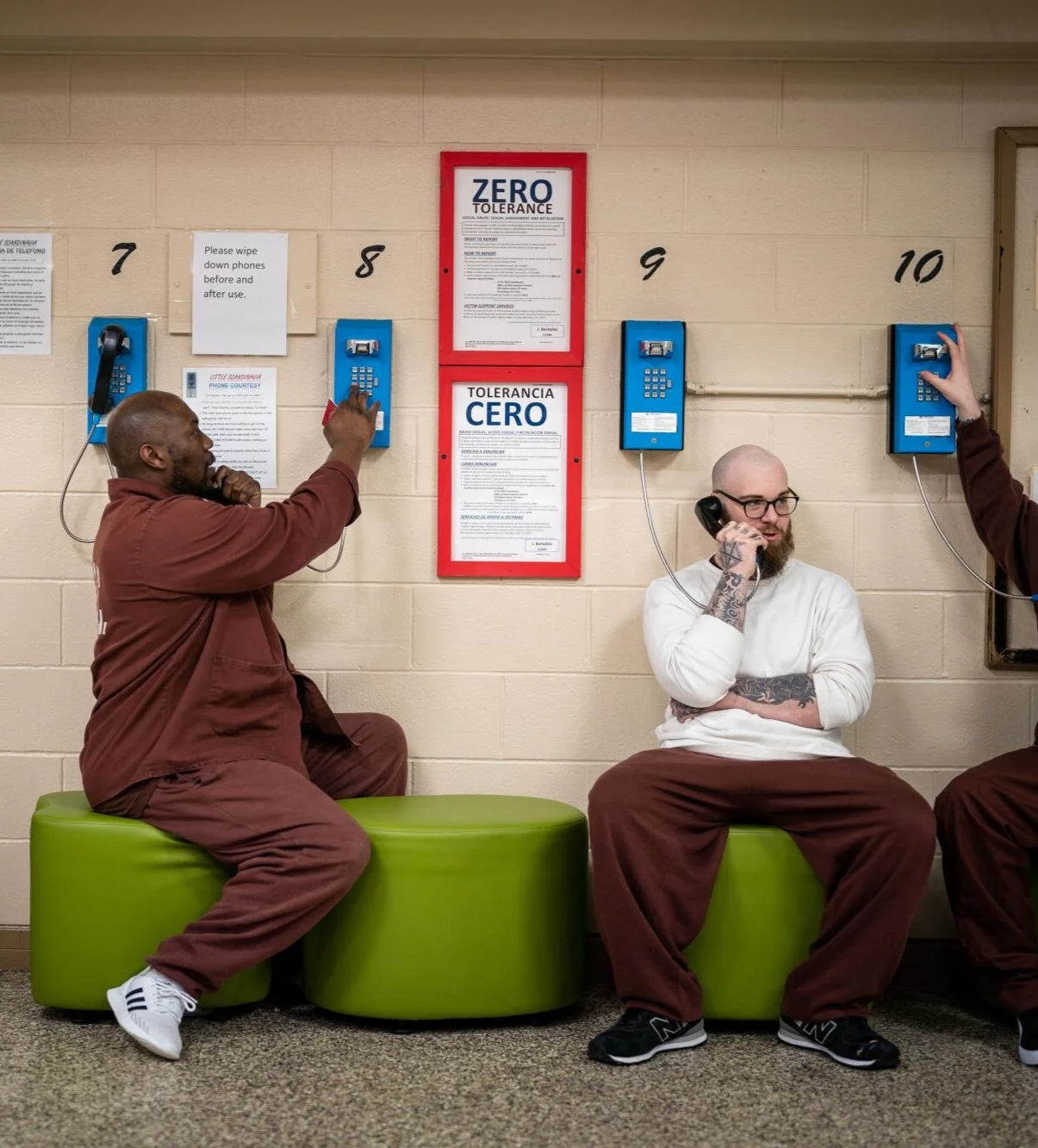
How does prison and jail communication work?
Correctional telecom is not a fair market. Incarcerated people cannot chose their phone provider like we do in the free world. They depend on the niche correctional telecom industry to maintain critical relationships with their loved ones.
Telecom providers compete for monopoly contracts awarded by correctional agencies. Until recently, agencies often awarded these contracts based on how much the providers were willing to pay them in commissions. This profit-sharing arrangement drove up costs, leading federal regulators to ban the practice and set rate caps. But the industry, along with it’s correctional partners, is consistently lobbying these regulators to allow them to charge more.
The bottom line is that incarcerated people and their families bear the cost of an arrangement they have no part in.
THE CORPORATIONS BEHIND THE HARM
Securus
Securus, whose parent company Aventiv also owns JPay, controls roughly 40% of the U.S. correctional telecom market. Until recently, the corporation was wholly owned by Platinum Equity. But after a defaulting on $1.6 billion in debt, creditors were forced to take over. Platinum Equity maintains a small stake in the corporation.
ViaPath
ViaPath, formerly Global Tel Link (or GTL), controls roughly 40% of the U.S. correctional telecom market. The corporation is owned by American Securities. It is also the parent company of Telmate and does business as ConnectNetwork and Getting Out. It’s platform is also used across immigration detention centers.
ICSolutions
ICSolutions controls roughly 10% of the correctional telecom market. The corporation is owned by HIG Capital and nested under its portfolio company TKC Holdings, which also owns the commissary firm Keefe and money transfer firm Access Corrections.